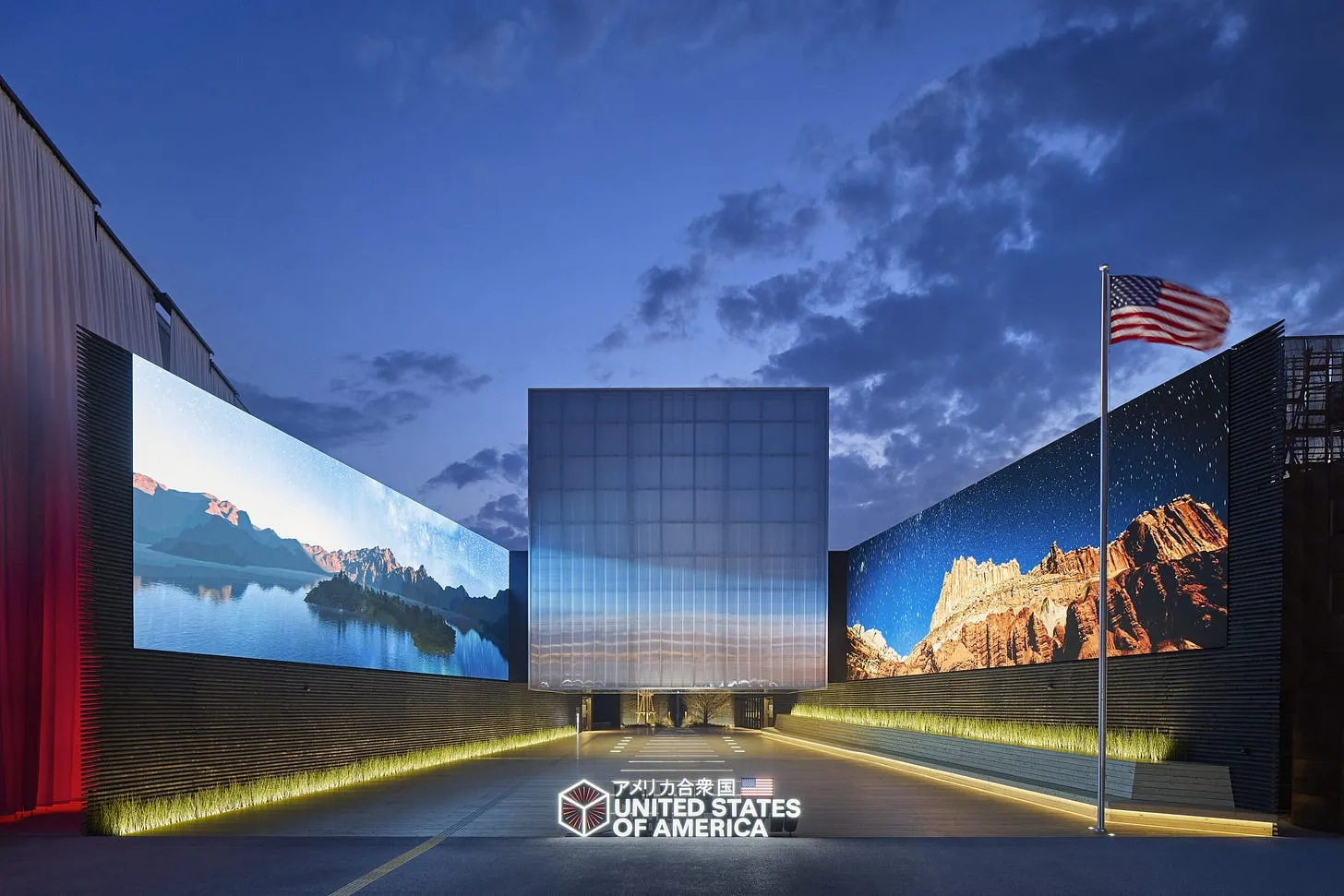
Every five years, countries gather for the World Expo, pouring millions of dollars and years of effort into stunning architectural projects that only last for six months. Each Expo is built around a theme (this year’s is “Designing Future Society for Our Lives”), allowing countries to respond with a blend of their unique history and future vision, all embodied in a pavilion. When visitors enter, they follow a story: a journey told through physical design, materials, exhibit order, and narration. World Expos provide an opportunity to strengthen or redefine a nation’s reputation in a small yet meaningful way.
So, when the USA pavilion opened with its theme, “Imagine What We Can Create Together,” it at first seemed like a rectification effort against previous years of isolationism and protectionism. But when the pavilion opened in April 2025, it was born into a world vastly different from the one in which its design and messaging were conceived in 2023. The United States has always struggled to align its internal messaging with its global reputation. It’s challenging to condense a country as diverse and ever-changing as the United States into a single piece of architecture with a single story. Still, Trahan Architects and the team behind the pavilion attempted to do so.
If this was the first experience with the USA for one of the ten thousand daily visitors, what would they see? They would be met with towering LED screens on muted walls, a utilitarian design, a digital assistant guide, and overt messaging reminiscent of the “I Want You” Uncle Sam poster. From this, they might imagine a country of billboards, profit margins, and human capital—and they would be right.
They would also be seeing the truth, however, if they paid attention to the other truths on display: the diversity in landscape, culture, and people; the unparalleled education and research pursued for its own sake rather than necessitating an unequal exchange; and the focus on innovation in technology, agriculture, and the final frontiers of space.
But if they understood the context, the tone the US was portraying at that moment versus the America the pavilion tried to capture, they would feel the dissonance. This America may or may not still exist, shrouded as it is by the zeitgeist. Even those who could not care less about the US were aware of the palpable irony as they walked through the pavilion.
The pavilion’s final exhibit on space exploration perfectly encapsulates this dissonance, capturing the past, present, and future, all colliding within three years. In 2023, its message was one of collaborative, pure research—a testament to America’s rich history of pioneering exploration. By the time of the 2025 opening, however, a new administration’s skeptical rhetoric and proposed budget cuts made that optimistic vision seem naive. The ephemeral nature of the World Expo itself, where pavilions stand for only a few months, implored visitors to consider the immediate contradiction.
Yet, just months into the Expo, the narrative shifted again. A renewed, urgent interest in space exploration emerged, driven not by the pure pursuit of knowledge but by an unofficial competition with China and the quest for geopolitical prestige. The sudden push to fully fund the Artemis program is a perfect example. A program the new administration initially dismissed as “globalist overspending” is now being championed as a critical national security imperative. The public rhetoric has shifted from exploration to domination, framed in purely nationalist terms: it’s a mission to ensure American boots are the next to land on the Moon, not Chinese ones. While the intentions are far from the “progression of mankind” the pavilion espouses, this rapid reversal underscores the core theme that change is not permanent. Just as quickly as things can turn, they can be redirected.
This same dissonance echoes through the other exhibits. Optimistic messaging about education and diversity is undermined by the administration’s real-world rhetoric and actions, which seek to limit student visa programs and research-sharing agreements while eroding the very inclusivity the pavilion celebrates by dismantling federal DEI (Diversity, Equity, and Inclusion) initiatives and reviving talk of broad new travel restrictions. It signals a return to the very era of isolationism the pavilion was ostensibly designed to rectify.
How, then, does one define an American pavilion? Perhaps the answer is that this dissonance and public contradiction are the only honest definition. The “ugly” is the immediate, chaotic hypocrisy; the “bad” is the lack of a coherent, long-term national narrative in a country whose political winds shift so rapidly that any attempt to present a snapshot in physical form is destined to feel outdated by the time the idea leaves the studio.
However, this is where the national story takes a turn. What if the “good” America tells itself is that a slick, unified, state-approved message would be the far greater lie? In this reading, the chaos doesn’t betray the nation’s true ethos; it is the ethos: one of constant, messy, and very public debate. Unlike nations defined by millennia of history, the US is unburdened by a fixed identity, free to redefine its dreams. In this light, an American pavilion is destined to be a snapshot—a “time-stamped” message—rather than a timeless monument, falling more in symphony with the passing nature of the World Expo itself.
The defining hope of 2023, “Imagine What We Can Create Together,” becomes powerful in this context precisely because it is a hope, not a statement of fact. It’s an invitation to a process and frame the relentless turnover of American leaders—from Obama to Trump, from one party to the next—not as instability, but as the visual proof of that messy, public process, a “marvel” of democracy unfolding.
The core thread, the argument goes, isn’t a fixed belief or a shared direction. The core thread is the argument itself of the restless, foundational belief that the current vision is not the last and that the people have the right to tear it down and build a new one. Seen this way, unity is the shared, chaotic system of re-evaluation.
It may not be a failure of imagination for the architecture of the pavilion to be a “utilitarian” box with “towering LED screens.” The American pavilion is not a marble temple to a fixed ideal; it is a media device, a temporary vessel whose walls are designed to display a message, and by implication, to be rewritten. The medium is that American identity is not carved in stone; it is a digital display.
The lesson of 2025 would be not to try harder to find a message that will last, but to stop trying to freeze a single message at all. One could even suggest that for the next World Expo in Riyadh, the USA pavilion should be a “pavilion of arguments,” a space brave enough to showcase the debate itself to the world. The goal would not be to hide the dissonance, but to design a stage that rebrands this restless, unceasing, and public evolution as the American contribution to “Designing Future Society.”
How will America design a future society? If this pavilion is any guide, it will be by loudly and constantly remaking itself, building a future that does not resemble today.