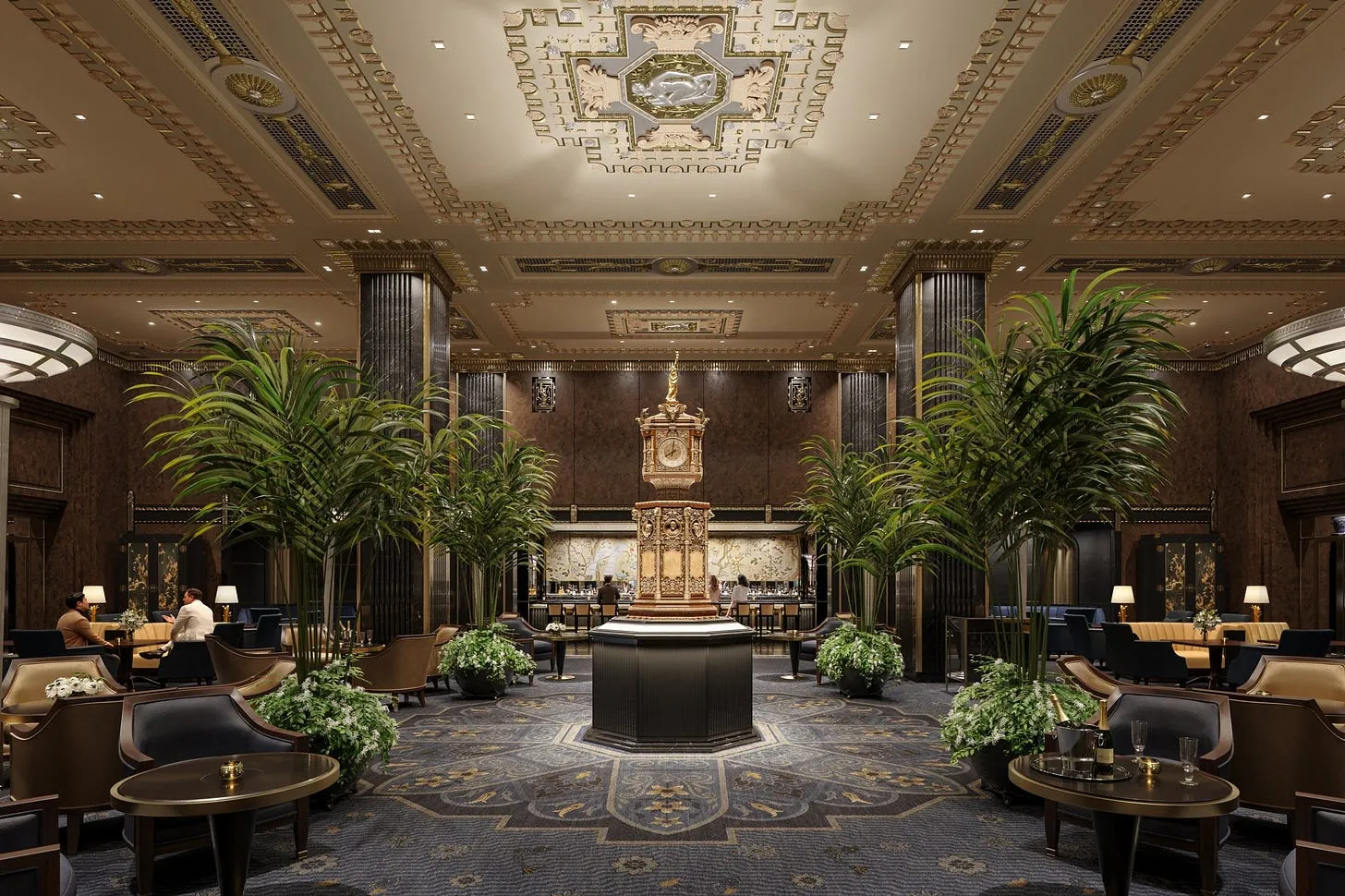
The Waldorf Astoria lobby remains open to the public. So why does walking into it feel like trespassing? Walking into the lobby, you’re enveloped in restored Art Deco grandeur, with soft ambient light gleaming off the inlaid marble of the Wheel of Life mosaic and the rich, warm wood veneer. The space feels vast yet intimate, inviting you to take a seat in the refined Peacock Alley. At the very center of the lobby is the magnificent 1893 clock, returned to its full splendor.
But as you look around at the crowd, you realize there isn’t one.
For over a century, New Yorkers used the phrase “meet me at the clock,” referring to the two-ton gilded clock at the Waldorf Astoria hotel. This tradition formed organically as a circumstance of the time. Before smartphones, it was easier to specify a landmark that was common knowledge to meet at, rather than a cross street or address.
Because of the hotel’s central location in Midtown Manhattan and the clock’s rich history as a gift from Queen Victoria for the 1893 World’s Fair, it became an iconic location where people met before heading to their final destination. It was easy to find a spot in the lobby and wait for your person while watching the sea of bodies pass through. Over time, meeting at the clock became a beloved tradition and a part of New York’s cultural lore.
The hotel itself was described as a “city within a city.” The rooms were expensive but achievable for a milestone stay. The Grand Ballroom could be rented for weddings and galas, tourists wandered in to observe the Art Deco splendor, and business lunches happened in Peacock Alley alongside celebrity sightings. You might spot a diplomat heading to a meeting, or a family from the Midwest posing for photos, or conference attendees killing time between sessions. High-profile figures moved through the same lobby as everyone else, creating what felt like democratic glamour—luxury you could witness even if you couldn’t afford to stay. The lobby served as a third space in the truest sense, somewhere you could simply be in the city, watching it flow around you.
After an eight-year, two-billion-dollar renovation, the question becomes less about what changed and more about what remains. Structurally, the hotel was entirely rebuilt. Architects tore out 96% of the building’s interior—essentially a complete “back-to-bare-steel” rehab—creating a new building within the historic shell.
1,400 rooms became 747, split between 375 hotel rooms and 372 private residences. Beyond the 50% reduction in rooms, consider that nearly half the building now houses condominiums rather than hotel guests. Those who can afford a Waldorf penthouse likely own homes in Aspen, London, the Hamptons. They are here intermittently, if at all, staying as part-time residents of a building that once pulsed with full-time life. And finally, consider that these residents enter through their own porte-cochère on 50th Street, bypassing the public lobby entirely. The very people whose presence once lent the space its peculiar magic—celebrities and dignitaries moving through a public room—now have a separate entrance.
What remains is a lobby that feels less like a crossroads and more like a destination. The old Waldorf was a place you passed through, a grand, chaotic intersection where conference attendees, tourists, businesspeople, and the ultra-wealthy collided accidentally. Today’s visitors arrive with intention: for a drink at Peacock Alley, a meal at the Michelin star restaurant, a photograph with the clock. Cole Porter’s restored piano sits in the lobby, and guests are welcome to play it gently. Even this gesture, lovely as it is, speaks to the shift. The lobby is no longer a living room but a kind of museum.
The clock stands as magnificent as ever, but it presides now over a different kind of gathering place, where the tradition of “meeting at the clock” has become less an organic urban habit and more a curated heritage experience. The clock has been franchised to every Waldorf Astoria worldwide, a gesture that both preserves and dilutes the original.
Other elements of the hotel’s fabric have undergone similar transformations. The Grand Ballroom, once bookable by anyone with the budget for a milestone event, now requires credentials for entry. Peacock Alley remains accessible, but everything about the space signals a shift from public gathering place to private amenity. These small calibrations quietly announce who the building is for now, and that this is a place for observation rather than function.
But these changes reflect something larger than one hotel’s renovation.
The clock tradition emerged because people needed a simple solution to the coordination problem of meeting in a city before we all carried computers in our pockets. It persisted because it worked, and because the Waldorf lobby was genuinely the kind of place where you could linger without obligation. The hotel’s restoration is impeccable. But just like visiting your childhood home after it’s been renovated by its new owners, it may be better, but it’s not yours anymore.
Imagine any public landmark relocated to a luxury courtyard. The object unchanged, but surrounded by doormen and private entrances. You could still see it, even meet at it, but would you? The landmark would become the destination rather than the waypoint. You’d go to it and leave, rather than pass through or gather nearby.
The lobby that once hosted thousands of daily interactions now serves hundreds. The spontaneous has been replaced by the curated. “Meet me at the clock” persists as a phrase, but it’s been adopted by the hotel’s marketing team, turned into a hashtag. The quietness isn’t only about the tradition. Grand hotel lobbies have historically functioned as “third spaces” where a cross-section of society could mingle, conduct business, or simply exist in a beautiful setting without the obligation to purchase or perform. The old Waldorf lobby was chaotic partly because it was democratic. It couldn’t control who entered, only manage the flow.
The restoration is genuinely beautiful, yet the feeling persists that we’re being offered something that looks like what we had but functions much differently.