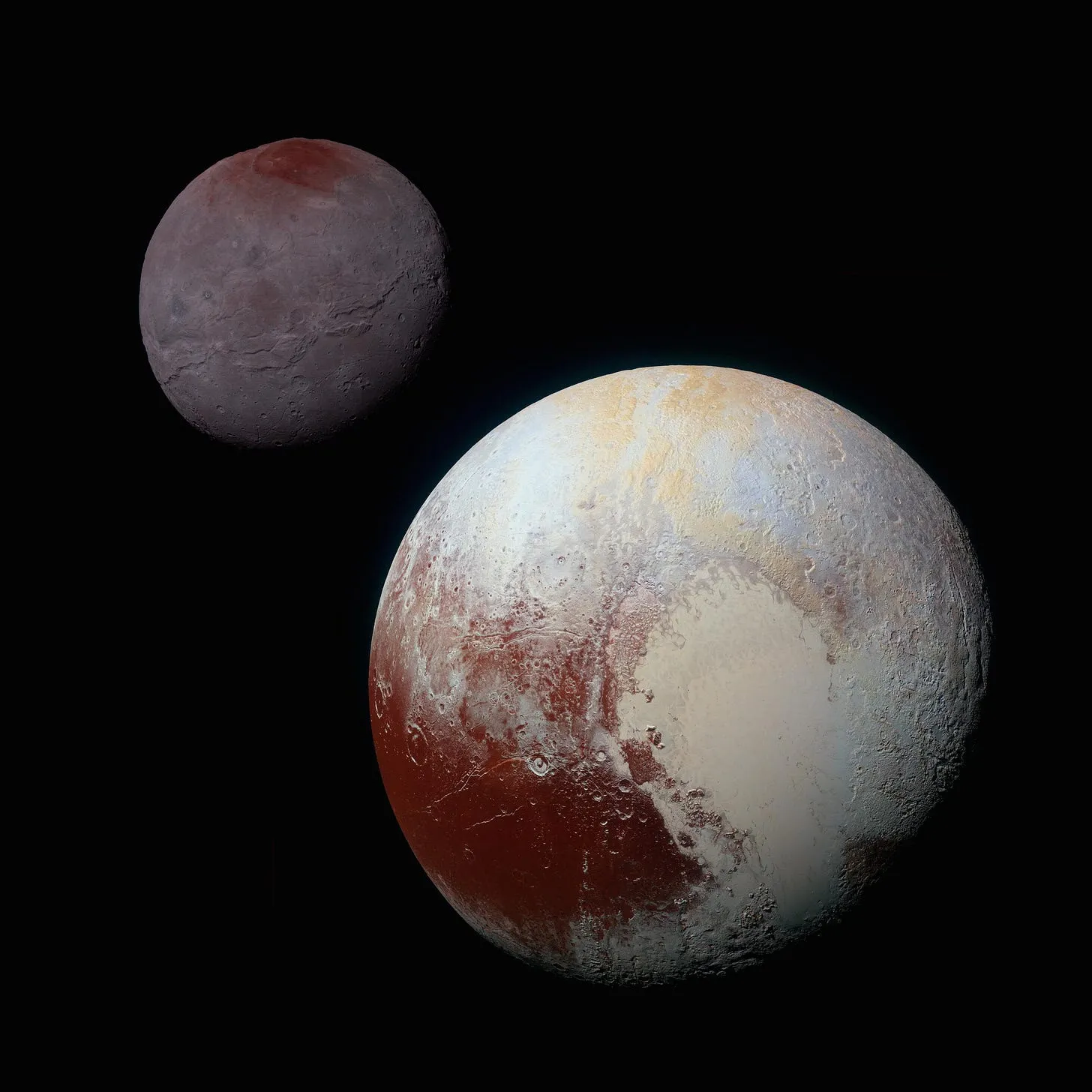
In a nearly three-day dance, Charon collides with Pluto as they begin to revolve together, and when they finally decouple, Charon becomes Pluto’s moon. Researchers challenged decades of assumptions by accounting for Charon’s ice and rock composition when simulating a different type of collision between Pluto and Charon. This discovery would support the theory of a subterranean ocean in the former ninth planet despite its distance from the sun and an origin story for other planet and moon relationships in the deepest parts of our solar system.
Researchers from the University of Arizona and the University of Bern, Switzerland, built upon previous research to determine how exactly Pluto got its moon. Dr. Adeene Denton, who led the study, shared that “most cosmic collisions are what we call a hit-and-run, when an impactor hits a planet and keeps going, or an impactor hits a planet, and they merge, which is called a graze and merge,” but Denton’s team found that simulating for Pluto’s and Charon’s unique rock, ice structure and the fact that both bodies maintained their structural integrity led to an entirely new type of collision: “the ‘kiss and capture’ scenario where the bodies collide, stick together briefly and then separate while remaining gravitationally bound,” said Denton.
The study not only correctly models the creation of Charon but also puts it in the right orbit around Pluto, while tracing the geology of Pluto and Charon correctly. Previous models suggested that any impact caused a high exchange of mass between the two bodies, but the discovery of a collision and separation meant that both Pluto and Charon retained much of their original composition. There would be enough friction from the collision and separation to provide Pluto with a subsurface ocean and point to water sources beyond Earth.
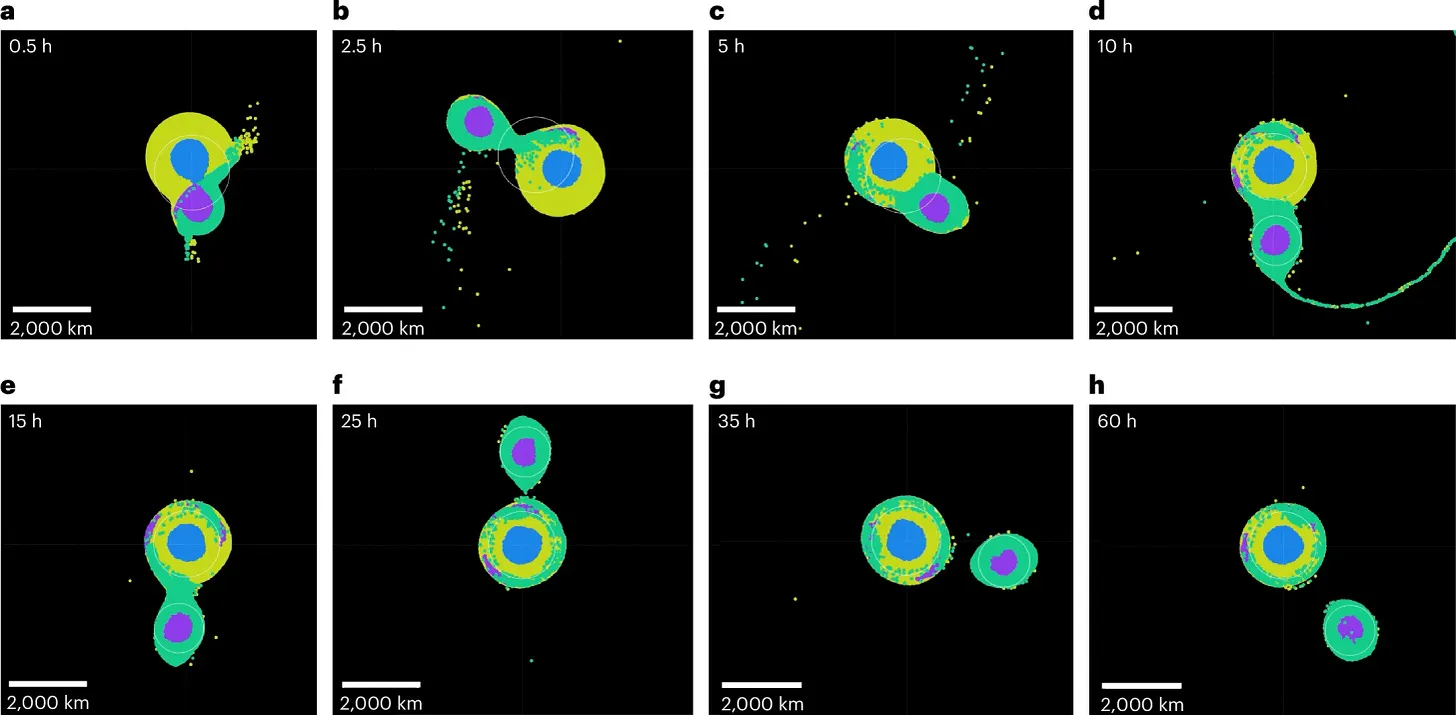
Time series of a potential Charon-capturing collision at 45°.
The team numerically modeled the collisional capture of Charon by Pluto using simulations that included the material strength of the two bodies. They knew from previous research that since Pluto and Charon shared an external orbital axis, there was likely a linked evolutionary history and collisional origin.
By taking into account the material strength of Charon to Pluto, they found that the two became temporarily connected due to friction distributing the impact momentum of the collision. Upon separation, tidal friction deposited considerable internal heat into both bodies.
When modeling different simulation parameters for each variable, like the angle of collision ratio of velocities and the spin, the “kiss-and-capture method was more likely than typical collision outcomes like ‘merger’ or ‘hit and run.’
Previous research used much simpler models that mimicked the formation of our Earth-moon pair. But “Pluto and Charon are different – they’re smaller, colder and made primarily of rock and ice. When we accounted for the actual strength of these materials, we discovered something completely unexpected,” Denton said. By developing this more robust model, the team is on track to investigate the existence of a subterranean ocean on Pluto and explain the formation of other planet-moon systems.
See more on: Nature Geoscience (Journal)