Lizards in the desert are feeling the heat—and it’s not just the rising price of eggs causing stress. Climate change is squeezing their ability to hunt and forage, leaving them hotter and hungrier.
A new study by researchers at the University of Melbourne investigated 10 species of desert lizards across Africa and Australia to understand how rising temperatures impact their energy budgets. The findings highlight an alarming trend: as temperatures climb, ectotherms—cold-blooded animals that depend on external heat to regulate their body temperature—face rising metabolic expenses while losing precious hours of foraging time.
At the heart of the problem is what the researchers call a “cost-of-living squeeze.” As temperatures rise, these lizards require more food to meet their increasing energy demands. However, hunting or foraging for food generates heat, further limiting their activity. To survive, they must consume more food per hour of activity to reach a “minimum viable income,” the baseline energy needed to sustain their bodies, grow, and reproduce.
“In other words, it’s like diurnal lizards paying higher bills with fewer work hours, while nocturnal lizards can counter high bills by gaining extra work hours during the warmer nights,” lead author and University of Melbourne researcher Dr. Kristoffer Wild said.
The problem is especially dire for diurnal species active during the day. In desert habitats, where food and cool retreats are scarce, lizards typically take a mid-day siesta to avoid the hottest temperatures. But as climate change pushes temperatures higher, this siesta becomes a prolonged slumber, further reducing their opportunities to hunt and forage.
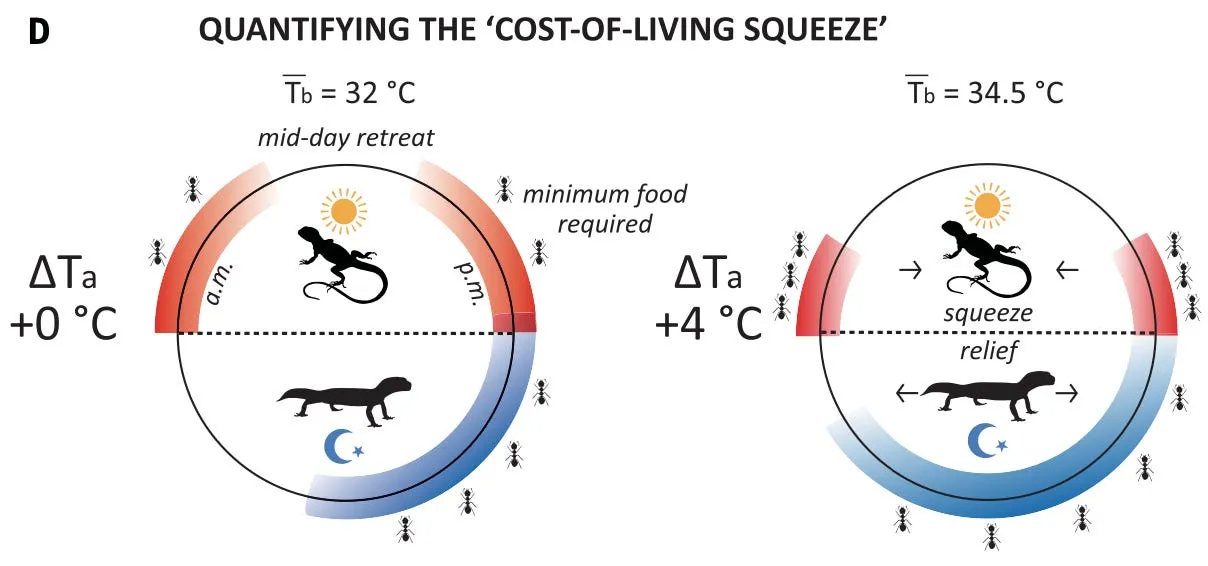
Colored traces on the edge of the circles indicate available foraging times with food (red, diurnal; blue, nocturnal) and how squeeze can change under present conditions (left) and +4°C warming (right).
The researchers found that, from 1950 to 2020, summer foraging times decreased significantly due to rising temperatures. This loss of foraging hours coincides with the biologically critical spring and summer months when lizards reproduce. During this time, energy demands peak, making the stakes even higher.
Interestingly, the study revealed that warming doesn’t drastically reduce total activity durations, thanks to lizards’ ability to use behaviors like seeking shade or burrowing to regulate their body temperature. However, it still increases metabolic rates, creating an energy deficit that is hardest to overcome in arid environments like deserts.
The researchers caution that their findings are conservative. Additional factors, such as declining insect populations, increased water evaporation, and food scarcity, could amplify the cost-of-living squeeze. They also note that the most vulnerable species are likely those living in desert environments with limited resources.
Future research will aim to incorporate variables like food and water availability into these models, providing a clearer picture of how lizard populations might adapt—or fail to adapt—to a warming world. Understanding these dynamics is crucial for conservation efforts, as desert ectotherms are on the front lines of climate change’s impacts.
“If we can better understand the ecological processes underpinning these cost-of-living pressures, we can better anticipate the species most at risk and act accordingly.”
See more on: Science (Journal)