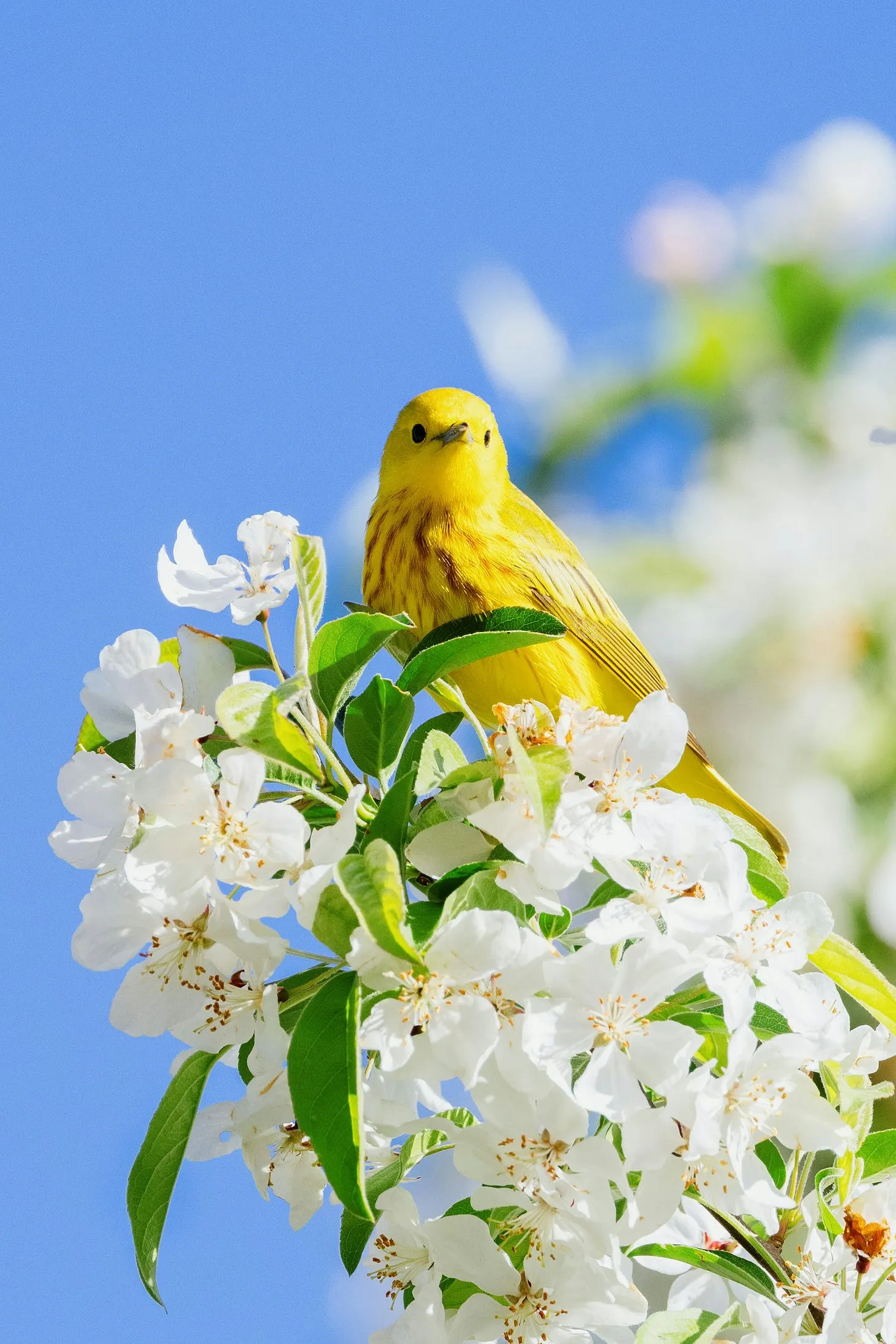
Click here to listen to the Yellow Warbler’s song
Instead of surrendering to urban noise, yellow warblers amplify their territorial songs, but when city traffic drowns them out completely, these tiny yellow defenders resort to physical confrontation.
You’ve probably heard these birds singing in the spring and early summer with their 6-10 whistled notes. But these birds aren’t just singing a sweet tune.
Birdsong is one way birds can communicate territory borders without actually engaging in combat. However, if traffic noise increases, birds will adapt their singing patterns depending on their experience with noise.
Birds living within 50 meters of the road are typically accustomed to the rumble and roars of traffic. They know their songs won’t reach the ears of their intruder, so they abandon them and attack the threat instead.
Birds who live further away from the road try to increase the frequency and maximum volume of their songs instead of confronting another yellow warbler.
Researchers from the University of Vienna, Anglia Ruskin, and Flinders published a new study in the Animal Behavior journal describing the impact of simulated vehicle and song noises on Galápagos yellow warblers.
They wanted to test whether birds change their signals depending on their experience with high noise. They studied on two islands: Santa Cruz, a relatively busier island, and Floreana, a quieter island.
Combining traffic recordings in Santa Cruz and songs from other yellow warblers, they blended birdsong with traffic noise to play to yellow warblers. With the JBL speaker clipped to a branch, two observers watched how the yellow warbler would respond to rival warbler songs.
While all yellow warblers approached and attacked the speaker, there was a considerable difference in behavior between those who resided near the road and those who lived away from the road.
“We also found some evidence of birds trying to cope with noise by adjusting their song, with yellow warblers in all habitats increasing the minimum frequency of their songs to help them be heard above the traffic noise,” explains Dr. Akçay.
Birds living near the roadside increased their aggression levels with added noise, while birds who lived further away from the road decreased their aggression.
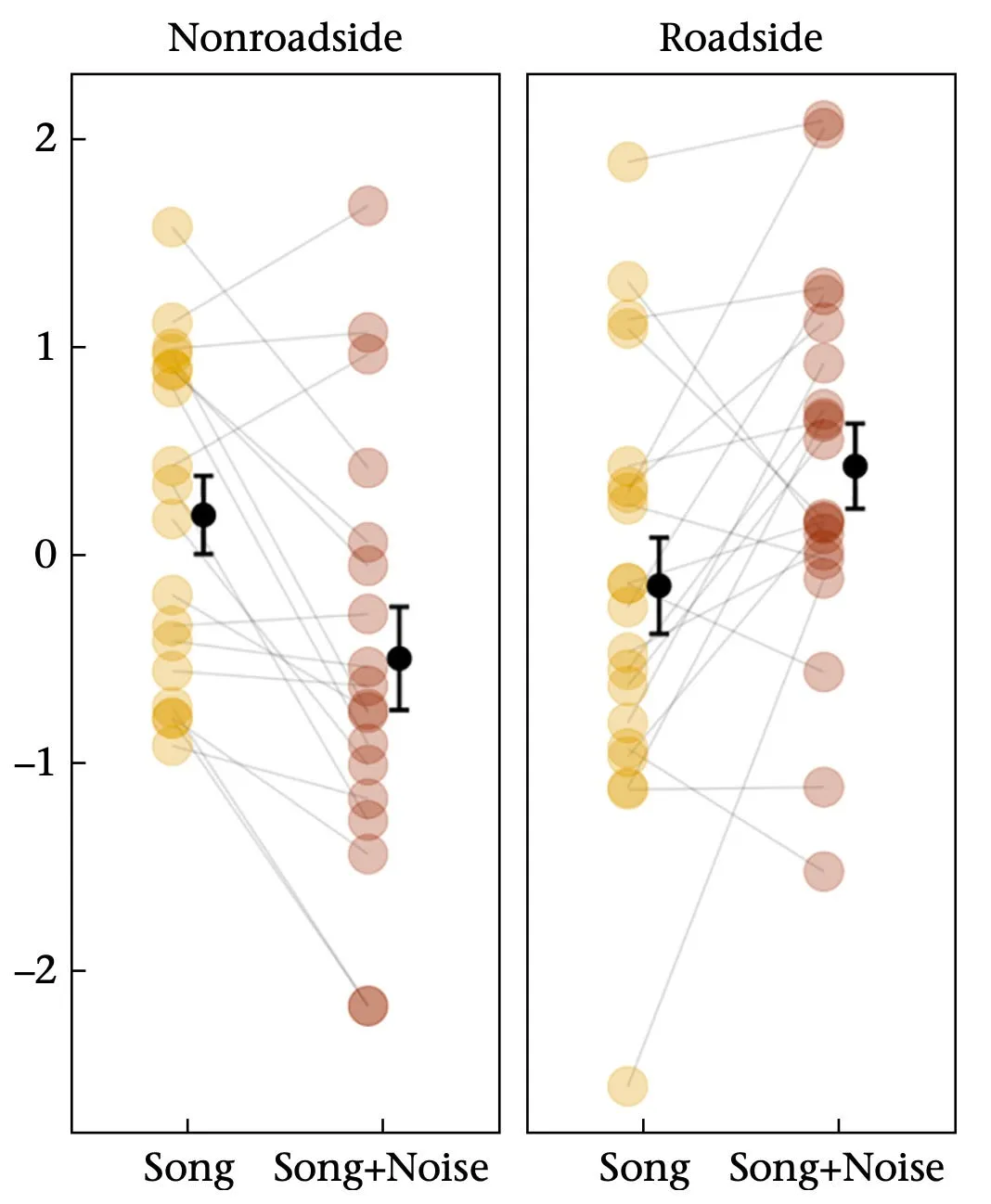
Change in response to treatment, showing mean ± SE for aggression scores (PC1) in control and experimental trials depending on island and distance to the road.
The researchers suggested that if songs are used to induce territorial defense and resolve conflict, interference with that noise will reduce effective signaling and increase aggression.
The finding that even slight exposure to traffic can influence aggressive behavior has implications beyond the Galápagos. Similar patterns of noise-induced aggression have been observed in other species, including humans.
“Our study shows the importance of considering behavioral plasticity in conservation efforts and developing strategies to mitigate the effects of noise pollution on wildlife,” says Dr. Akçay. “It also highlights the significant impact of human activities on wildlife behavior, even in relatively remote locations such as the Galápagos Islands.”
See more on: Animal Behavior (Journal)